UK Poultry and Poultrymeat Statistics - May 2008By Defra. This monthly publication combines the UK Hatcheries Survey and Poultry Slaughterhouse Survey results together with other Defra statistics, and trade data.
Notes:
The percentage changes shown are calculated using unrounded figures. Thus any percentage changes calculated using the published (rounded) figures may not equate exactly with the changes shown.
The UK 12-month moving totals represent the sum of the 12 months up to and including the date indicated. They should be seen as a trend measure that is not affected by seasonality.
The Hatcheries Survey is statutory with all registered hatcheries taking part in the survey for England & Wales. The Scottish Executive for Environment and Rural Affairs Department (SEERAD) and the Department of Agriculture and Rural Development (DARD) conduct similar surveys and contribute data towards the UK totals.
All trade data contained in this statistics notice is based on official Revenue and Customs Trade Data.
The Poultry Slaughterhouse Survey is a voluntary sample survey of registered slaughterhouses only.
Poultry meat production is calculated using average slaughterhouse survey liveweights and industry advice on liveweight to carcass weight conversions, lifespan and mortality. Includes estimates for slaughterings on-farm and at unregistered slaughterhouses.
Poultry feed data have been sourced from two surveys, one carried out by Defra and one by DARD. The survey of ‘Animal Feedingstuffs and Raw Materials’ is a statutory monthly survey of all known compounders in Great Britain, and the DARD survey ‘Deliveries of compound and other processed animal feedingstuffs by Northern Ireland feedstuffs manufacturers’ is a monthly survey of feed compounders in Northern Ireland. The survey of ‘Poultry feed production for units with large flocks’ is a voluntary monthly survey of all integrated poultry units with more than 50,000 birds.
All charts are numbered in accordance with the relevant table containing the corresponding data.
EU placings data have been withdrawn from this notice, and will only be shown when new data become available. However, the dataset containing EU placings data (containing data from 1996 to 2006), can be found at: http://statistics.defra.gov.uk/esg/datasets/euplace.xls
Section 1 UK Hatcheries Data - Placings and Eggs Set
Chart 1.1: Monthly UK Commercial Broiler Chick Placings
Chart 1.3: Monthly UK Turkey Poult Placings
Section 2 UK Trade in Live Poultry
Chart 2.1: Imports and Exports of Commercial Broiler Chicks
Chart 2.2: Imports and Exports of Turkey Poults
Section 3 UK Slaughterhouse Data - Numbers Slaughtered and Average Weights
Chart 3.1: Monthly Broiler Slaughterings in UK
Section 4 UK Poultrymeat Production, Trade and Domestic Usage (Net of Offal)
Chart 4.2: Imports of Whole Birds and Cuts
Chart 4.3: Exports of Whole Birds and Cuts
Chart 4.4: Total Poultrymeat Imports and Exports
Link to Main Report
To view the full report, including tables (PDF - 14 pages), please click hereMay 2008
Sunday, June 8, 2008
Tuesday, June 3, 2008
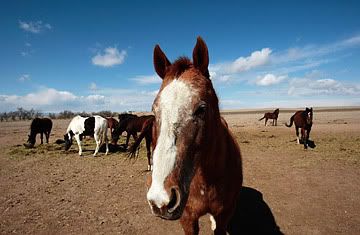
An Epidemic of Abandoned Horses
Horses congregate at Denkai Animal Sanctuary in Carr, Colorado. The pace of animal rescue has skyrocketed the past year, especially for horses, as people from Colorado who have lost their properties in the national housing crisis abandon them when they move out.Chris Hondros / Getty
The global food and fuel crisis is resulting in more than just people going hungry. Rising grain and gas prices, as well as the closure of American slaughterhouses, have contributed to a virtual stampede of horses being abandoned — some starving — and turned loose into the deserts and plains of the West to die cruel and lonesome deaths. Horse rescue projects, which are mostly small, volunteer operations with limited land and resources, are feeling the consequences of this convergence of events. In the meantime, many now unaffordable horses are being sold to abbatoirs south of the border where inhumane methods of slaughter are practiced.
"It's a growing problem. Basically, it's the economy," says Brent Glover, who has run Idaho's Orphan Acres since 1975 and has found new homes for 1,600 rescued horses. "We're getting calls constantly." With more horses coming onto his 50-acre refuge, he is feeling the pinch of a hay bill that has risen from $28,000 to $80,000 this year, not to mention rising transportation and grain costs. "It's a horrible mess of bad consequences," says Colorado State University animal sciences Professor Temple Grandin. "People are turning them loose because of the decline in discretionary spending."
Outside Pueblo, Colorado, 101 rescued horses graze on 850 acres at Dreamcatchers Equine Sanctuary, and more are on the way. "It's a very scary situation right now," explains manager Julie DeMuesy. "Everybody's stressed to the max. It exploded for us at the end of 2007." Some horses are coming from people who have had their mortgages foreclosed, and can't afford to feed their steeds. "We're trying desperately to reduce our herd [by sending horses] to good homes. It's become a revolving door — They're coming in as fast as they are going out to new homes."
And the problem isn't limited to the West. Earlier this week, nearly 120 starving horses (along with some ponies and donkeys) were taken from a ranch of a Central Florida woman who had become overwhelmed by the demands of caring for the rescued animals.
Another reason for the rise of numbers, in addition to economics, is the absence of U.S. slaughterhouses. (The last three were shut in 2007 after several court rulings came down against horse slaughter for human consumption.) Says DeMusey: "We're seeing a lot of elderly horses and horses with special needs that normally would be sent to slaughter." Says Montana livestock transporter John Chaffee: "What can you do with all these horses? You can't bury 'em all. I have nothing against eating horse meat. I wouldn't eat it, but millions of people in the world do." Chaffee says he has stopped hauling horses to a plant in southern Alberta, Canada, because of costlier trucking restrictions and Canadian humane-group pressures at border crossings. "People who protest slaughter ought to have a bunch of these old horses starving to death in their backyards."
Colorado State's Grandin, who helped refine standards for humane livestock slaughter, says Americans have an "ick" factor when it comes to the idea of horseflesh, equating it, she says "killing and eating pets." But, Grandin argues, "the problem is, these are 800- to 1,200-pound pets. When they shut down those plants, I said we've got to avoid alternatives worse than slaughter. But we have not, and all my worse nightmares have come true."
Chaffee says horses that are taken north to Canada are treated humanely. But with the long-distance hauls now being prohibitive, horses in the southern U.S. are being laundered through a series of dealers into Mexico. Says Colorado State's Grandin: "At the Mexican border, they just wave the trucks through. The conditions down there are horrible." Proposed legislation to outlaw U.S. horses for slaughter may get passed, says Grandin, but the law won't be enforceable because Mexican "kill buyers" can circumvent the law by labeling horses as breed stock or for riding purposes. And such a law may not ameliorate the plight of American horses in an economic downturn.
Longtime Montana horse breeder Kathy Thornton says she will cut back on the number of her brood mares producing offspring every year, because of high costs of feed and transportation, plus the sudden drop in value of her well-tempered colts. A three-year-old trained ranch horse that traditionally would bring upwards of $1,500 fetched only $525 at a sale 175 miles away, a transaction that cost her $200 in truck fuel. "I'm open for barter," says Ms. Thornton. "I'm now trading horses for cattle. Personally, I don't send horses to slaughter, but I'm glad if it's available. I sure feel bad for the poor horses left alongside the highway."
By PAT DAWSON
Thursday, May 29, 2008
LIVESTOCK
Washington, May 30 2008- Two companies are recalling livestock and fish feed ingredients because they contain the same chemical linked to the deaths of cats and dogs from tainted pet food, U.S. health officials said on Wednesday.
The presence of melamine and related compounds in feed ingredients sold by Uniscope Inc. and a unit of Tembec Inc. was unrelated to the pet food contamination by ingredients from China, the Food and Drug Administration said.
Officials said Tembec confirmed it intentionally added melamine to improve the binding properties of ingredients used to make feed pellets. Melamine is not an approved feed additive.
Investigators are unsure how many animals may have consumed tainted feed. Officials said melamine levels were low and it was unlikely humans would be harmed.
"The companies have stopped adding melamine to the feed product," Dr. David Acheson, FDA assistant commissioner for food protection, told reporters. "FDA is advising feed manufacturers and others who mix their own feed not to use these products, and to contact the manufacturers."
Acheson said Ohio-based Tembec BTLSR, a unit of the Canadian wood products company Tembec, recalled AquaBond and Aqua-Tec II feed ingredients, which it distributes for Uniscope. Colorado-based Uniscope also recalled its Xtra-Bond product that was made with ingredients supplied by Tembec.
The products are binding agents used to make feed pellets for cattle, sheep, goats, fish and shrimp.
Tembec said it was cooperating with the FDA.
"We discontinued the use of melamine in our formulation earlier this spring," Tembec executive vice president John Valley said, adding "we're talking about a low concentration of an element that is in turn a low component of any feed product."
Uniscope originally notified the FDA about the contamination on May 18, agency officials said.
"We don't think the concentration is very high," said Charlie Russell, a spokesman for Uniscope. "But if FDA thinks it's a big deal I'm not sure we're going to disagree with it."
The FDA advised feed manufacturers to recall finished feed made with AquaBond or Aqua-Tec II. But it said no recall was warranted for finished feed made with Xtra-Bond because the levels of melamine and related compounds were lower.
Melamine is an industrial chemical used to make plastics and fertilizer. It had previously been discovered in vegetable protein concentrates from China that were used to make U.S. feed for pets, pigs, chickens and fish.
A federal government probe began in mid-March following reports of kidney failure in some dogs and cats. Pet food makers that used ingredients from two Chinese companies recalled more than 100 brands of melamine-laced feed. Sixteen dog and cat deaths were confirmed among thousands of reports.
A portion of the pet food was used in feed given to poultry, fish and hogs. While some of the animals may have entered the food supply, U.S. officials said it was unlikely that consuming them would pose a risk to human health.
Asked how long Tembec may have been adding melamine to its products, Acheson said "current thinking is this was not a practice that was done very recently but has probably been going on for a little while. We suspect this is not something that happened acutely in May 2007."
David Elder, director of the FDA's enforcement office, said the agency was investigating Tembec's actions and would consider if any action should be taken.
Acheson said some of the feed recalled on Wednesday may have been exported, and U.S. officials were notifying affected countries.
AquaBond and Aqua-Tec II ingredients were used in fish and shrimp feed both in the United States and overseas, while Xtra-Bond was used only domestically in livestock feed.
The presence of melamine and related compounds in feed ingredients sold by Uniscope Inc. and a unit of Tembec Inc. was unrelated to the pet food contamination by ingredients from China, the Food and Drug Administration said.
Officials said Tembec confirmed it intentionally added melamine to improve the binding properties of ingredients used to make feed pellets. Melamine is not an approved feed additive.
Investigators are unsure how many animals may have consumed tainted feed. Officials said melamine levels were low and it was unlikely humans would be harmed.
"The companies have stopped adding melamine to the feed product," Dr. David Acheson, FDA assistant commissioner for food protection, told reporters. "FDA is advising feed manufacturers and others who mix their own feed not to use these products, and to contact the manufacturers."
Acheson said Ohio-based Tembec BTLSR, a unit of the Canadian wood products company Tembec, recalled AquaBond and Aqua-Tec II feed ingredients, which it distributes for Uniscope. Colorado-based Uniscope also recalled its Xtra-Bond product that was made with ingredients supplied by Tembec.
The products are binding agents used to make feed pellets for cattle, sheep, goats, fish and shrimp.
Tembec said it was cooperating with the FDA.
"We discontinued the use of melamine in our formulation earlier this spring," Tembec executive vice president John Valley said, adding "we're talking about a low concentration of an element that is in turn a low component of any feed product."
Uniscope originally notified the FDA about the contamination on May 18, agency officials said.
"We don't think the concentration is very high," said Charlie Russell, a spokesman for Uniscope. "But if FDA thinks it's a big deal I'm not sure we're going to disagree with it."
The FDA advised feed manufacturers to recall finished feed made with AquaBond or Aqua-Tec II. But it said no recall was warranted for finished feed made with Xtra-Bond because the levels of melamine and related compounds were lower.
Melamine is an industrial chemical used to make plastics and fertilizer. It had previously been discovered in vegetable protein concentrates from China that were used to make U.S. feed for pets, pigs, chickens and fish.
A federal government probe began in mid-March following reports of kidney failure in some dogs and cats. Pet food makers that used ingredients from two Chinese companies recalled more than 100 brands of melamine-laced feed. Sixteen dog and cat deaths were confirmed among thousands of reports.
A portion of the pet food was used in feed given to poultry, fish and hogs. While some of the animals may have entered the food supply, U.S. officials said it was unlikely that consuming them would pose a risk to human health.
Asked how long Tembec may have been adding melamine to its products, Acheson said "current thinking is this was not a practice that was done very recently but has probably been going on for a little while. We suspect this is not something that happened acutely in May 2007."
David Elder, director of the FDA's enforcement office, said the agency was investigating Tembec's actions and would consider if any action should be taken.
Acheson said some of the feed recalled on Wednesday may have been exported, and U.S. officials were notifying affected countries.
AquaBond and Aqua-Tec II ingredients were used in fish and shrimp feed both in the United States and overseas, while Xtra-Bond was used only domestically in livestock feed.
Subscribe to:
Posts (Atom)